

Introduction — The New Rule of Advertising: Show a Human, Not a Product
If you look at every winning UGC ad, high-performing Reel, and top-converting TikTok, you’ll notice one thing:
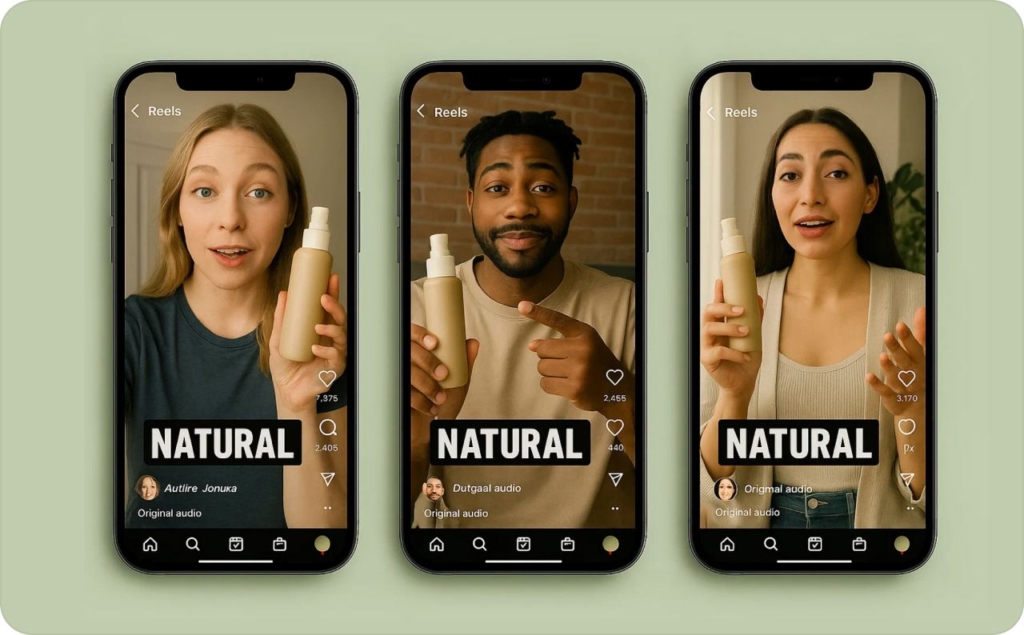
A human face appears in the first 1–3 seconds.
Not a product.
Not a logo.
Not a brand shot.
Not a studio scene.
A REAL PERSON.
This isn’t a coincidence or trend — it is a psychological requirement of modern content.
Consumers today ignore almost everything on their feed…
except humans.
This is why brands that use face-first content (UGC creators, casual clips, selfie-style videos) consistently see:
✔ Lower CPC
✔ Lower CPM
✔ Higher CTR
✔ Higher retention
✔ Higher conversions
✔ Longer ad lifespan
✔ Faster scaling
✔ Less creative fatigue
This blog breaks down why human presence reduces ad fatigue using neuroscience, consumer behavior, and algorithm logic — and why every brand must integrate face-first content into its core creative strategy.
Let’s dive deep.
1. Humans Are Hardwired to Pay Attention to Faces
The human brain contains a specific neural region called the fusiform face area (FFA).
It is designed ONLY to detect and process human faces.
This means:
- Your brain spots a face 10x faster than text
- Faces stand out in visual noise
- Faces trigger emotional processing
- Faces create psychological safety
- Faces activate empathy
- Faces increase focus
When an ad starts with:
- A product shot → the brain ignores it
- A lifestyle shot → the brain scrolls
- A logo → the brain disconnects
- A transition → the brain is confused
But when the ad starts with:
A real person looking into the camera?
The brain immediately says:
“This is important. Pay attention.”
This is why face-first UGC ads dominate.
2. Faces Create Instant Emotional Connection (The Empathy Trigger)
Consumers don’t connect with:
- Bottles
- Boxes
- Packaging
- Studio setups
- Models posing
- Product flying animations
They connect with humans showing emotions.
A face conveys:
- Happiness
- Surprise
- Confusion
- Curiosity
- Relief
- Pain
- Excitement
These emotions create an instant psychological bond.
When a creator says:
- “I didn’t expect this to work…”
- “You have to see this…”
- “This changed my routine…”
The viewer FEELS the emotion.
Feeling emotions = deeper engagement.
Deeper engagement = lower ad cost.
3. Faces Reduce Ad Fatigue Because Every Face Is Different
Studio ads look repetitive.
Polished videos look repetitive.
Influencers even look repetitive.
But when you use UGC creators, you get:
- Different faces
- Different expressions
- Different skin
- Different accents
- Different tones
- Different energy
- Different settings
This diversity reduces creative fatigue dramatically.
The brain gets bored of visuals it has seen before.
But it NEVER gets bored of new human faces.
This keeps your ads fresh for weeks or even months.
4. Face-First Content Feels Natural in the Feed
Modern feeds (Instagram, TikTok, YouTube Shorts) are filled with:
- Selfie videos
- Front-camera talks
- Real-life vlogs
- Reviews
- Reactions
- Skincare routines
- Try-ons
- Tutorials
So when people scroll, they expect to see humans, not “ads.”
Face-first UGC blends perfectly into this behavior.
This reduces:
- Skips
- Bounce
- Scroll-away
- Drop-offs
And increases:
- Watch time
- Retention
- Engagement
- Shareability
Authenticity = algorithm love.
And algorithms reward authentic content with lower CPM and wider reach.
5. Faces Trigger Trust Faster Than Any Brand Asset
Trust is the real bottleneck in advertising.
People don’t trust:
- Brands
- Logos
- Studios
- Celebrities
- Influencers
But they trust:
- Relatable people
- Real users
- Honest expressions
- Unfiltered reactions
UGC creators are essentially trust shortcuts.
A human face gives consumers:
✔ Psychological safety
✔ Social proof
✔ Emotional credibility
✔ Authentic vibe
✔ Realness
This trust reduces friction in the buying process →
which reduces overall ad cost and improves ROAS.
6. Faces Communicate More in 1 Second Than Brands Do in 15 Seconds
A creator’s expression can communicate:
- Surprise
- Skepticism
- Satisfaction
- Curiosity
- Excitement
These micro-expressions are impossible to replicate with studio production.
Consumers understand emotional cues instantly.
This lowers the cognitive load — making content easier to process.
When the brain processes content easily, it performs better in:
- Attention
- Retention
- Decision-making
Ads need to communicate quickly —
and faces are the fastest communication tool ever created.
7. Face-First Content Creates “Conversational Ads” (Not Promotional Ads)
Brands talk AT people.
Creators talk TO people.
Big difference.
When a creator looks into the camera and speaks like a friend:
- “Let me show you something.”
- “You need to stop doing this mistake.”
- “Here’s what shocked me today.”
…it feels like a conversation, not an advertisement.
Conversational content reduces:
- Resistance
- Skepticism
- Mental friction
Which directly lowers CPC and increases conversions.
Face-first = friend-first.
Friend-first = trust-first.
Trust-first = performance-first.
8. Human Presence Activates Mirror Neurons (A Powerful Buying Trigger)
Mirror neurons fire when we observe someone performing an action.
So when a creator:
- Applies a product
- Opens a package
- Uses a gadget
- Tries a skincare product
- Eats a food item
The viewer’s brain subconsciously imagines doing the same thing.
This is why:
✔ Demo videos convert
✔ Before/after videos sell
✔ Try-on videos go viral
✔ Routine videos get saved
✔ Tutorial videos build trust
Studio ads CANNOT activate mirror neurons.
Only real humans can.
9. Face-First Content Improves Landing Page Performance
When ads feature a face:
- Users click more
- Bounce rate drops
- Scroll depth increases
- Time on page increases
- Add-to-cart increases
Why?
Because the emotional connection from the ad carries forward into the landing page.
If the landing page also shows:
- Creator testimonials
- Face-first reviews
- Real customer videos
Your conversion rate increases immediately.
Authenticity creates a seamless funnel.
10. Face-First Ads Survive Longer Because They Generate Comments & Conversations
When viewers see a real person, they comment:
- “Where is this from?”
- “Does this actually work?”
- “I tried this!”
- “I want this too.”
- “OMG same problem!”
Comments create social proof loops.
Social proof loops:
- Boost ad ranking
- Reduce cost
- Build trust
- Extend lifespan
- Improve retargeting
Studio ads don’t generate conversations.
Face-first creators do.
And conversations = conversions.
11. Face-First Content Is the End of “Creative Fatigue”
Brands usually face creative fatigue because:
- Same product shot
- Same voiceover
- Same style
- Same transitions
- Same aesthetic
Face-first content solves fatigue by:
- Constantly changing faces
- Different accents
- New micro-expressions
- New settings
- New storytelling tones
- New personality styles
Every piece feels fresh — even if the script is similar.
This reduces production load, testing cost, and ad wastage.
12. The Future of Advertising: Human-Centered Creative
The next few years will see:
- Less studio production
- More UGC creators
- More conversational ads
- More selfie-style hooks
- More face-first storytelling
- More real-life settings
- More emotional content
Face-first content is not a “trend.”
It is the default behavior of human communication.
Humans sell to humans.
Humans trust humans.
Humans connect with humans.
13. How Brands Can Execute Face-First Creative (Practical Blueprint)
1. Use creators who speak naturally
Avoid influencer-style acting.
2. Start the first 2 seconds with a face
No product shots.
3. Use raw, unfiltered lighting
Natural > studio.
4. Add emotional micro-expressions
Surprise, joy, confusion, relief.
5. Build scripts around real conversations
Not corporate messaging.
6. Use “friend-to-friend” language
Keep it simple and personal.
7. Maintain fast pacing
Cut dead space.
8. Use multiple creators
5–10 creators reduce fatigue.
9. Prioritize authenticity over aesthetics
Real > perfect.
10. Scale ads with proven creators
Repeat with your best performers.
14.Creator Navigator
Brands struggle to find creators who:
- Look natural
- Speak naturally
- Have strong camera presence
- Understand human psychology
- Know emotional storytelling
- Know how to shoot face-first ads
- Don’t “act” like influencers
- Deliver consistent UGC weekly
That’s where Creator Navigator helps.
Creator Navigator gives brands access to:
✔ Real, authentic UGC creators
✔ Trained face-first performers
✔ Storytelling experts
✔ Conversion-oriented talent
✔ Affordable & fast creators
✔ Ad-ready UGC pipelines
If face-first content reduces ad fatigue,
Creator Navigator helps brands produce it at scale.
Conclusion — Humans Reduce Fatigue. Humans Increase Performance.
The most powerful creative tool in marketing is a face.
Not a camera.
Not a studio.
Not a transition.
Not a celebrity.
Not an agency.
A real human talking to another human.
This is why face-first content:
- Lowers ad cost
- Improves ROAS
- Extends creative life
- Reduces fatigue
- Builds trust
- Creates emotional connection
- Drives conversions
The brands who embrace human-first content will dominate.
The brands who ignore it will continue burning ad spend on soulless studio ads.
Because in 2025 and beyond…
**Authenticity wins.
Realness sells.
Humans outperform brands.
And faces beat products — every single time.**