
The Death of Influencers: Why UGC Creators Are the New Celebrities of D2C
Introduction: The Influencer Empire Is Crumbling
For nearly a decade, influencers controlled brand attention.
One post from a big influencer could sell out a collection.
One collab could bring massive reach.
One shoutout was enough to build credibility.
But today, in 2025, something big has shifted.
Brands are quietly pulling budgets away from influencers.
Consumers are no longer impressed by sponsored posts.
Engagement is falling everywhere.
And what was once “influence” now feels like an overused marketing gimmick.
But it’s not because influencers suddenly became “bad.”
It’s because consumer psychology evolved.
People no longer trust famous faces —
they trust real faces.
And that’s why influencers are dying, while UGC creators are rising as the new celebrities of the digital world.
This is not a trend.
It’s a massive cultural shift.
Let’s break down why.
1. Influencers Lost Trust — And Trust Is Everything
Consumers today can smell a sponsorship from miles away.
They know:
- Influencers get paid big money
- Influencers push anything for money
- Influencers exaggerate
- Influencers hide negatives
- Influencers often don’t use the product
- Influencers follow brand scripts
And once trust breaks, influence dies.
The irony?
Influencers have the biggest reach…
but the smallest trust.
Meanwhile, UGC creators have:
- Small following
- Small production
- Small budgets
- Small fame
…but massive trust.
Because they feel like real, everyday people.
2. Influencer Content Feels “Performed” — UGC Feels “Real”
Influencers rely heavily on:
- Heavy makeup
- Perfect lighting
- Camera crews
- Brand scripts
- Clean backgrounds
- Edited videos
- Filters
The content looks beautiful —
but it no longer looks real.
UGC creators, on the other hand:
- Shoot on phones
- Use natural light
- Speak casually
- Show mistakes
- Show real skin
- Capture real environments
- Give real reactions
This rawness is what attracts audiences.
The modern consumer prefers:
- A girl reviewing a product in her bedroom
over - A celebrity talking about the same product in a studio
The raw content wins.
The polished content loses.
This is why UGC creators outperform influencers in D2C.
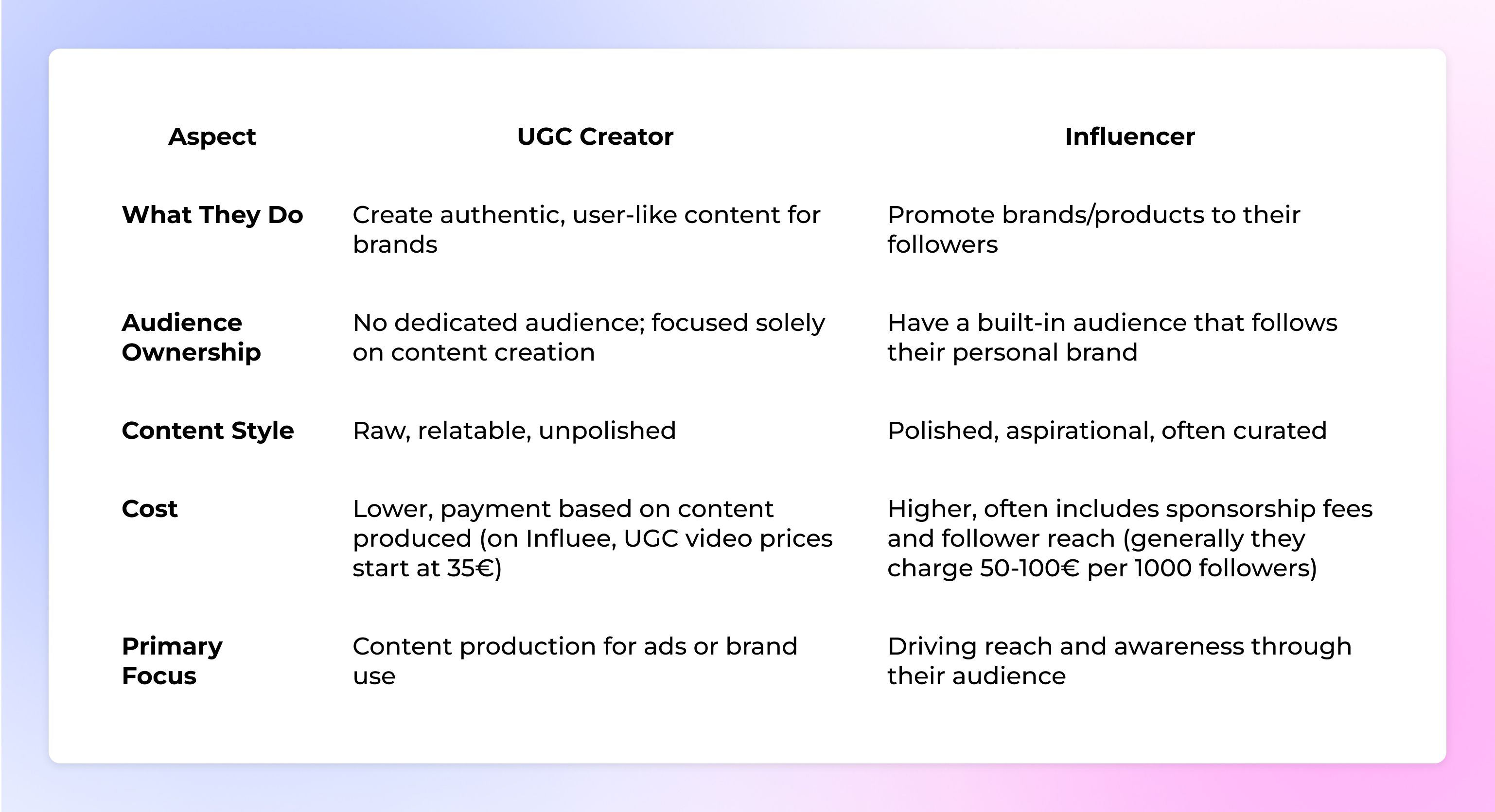
3. Influencers = Expensive. UGC Creators = Profitable.
Let’s compare cost realities.
Influencer cost:
- Micro influencer: ₹15,000–₹70,000 per post
- Mid influencer: ₹1–5 Lakhs per post
- Top influencer: ₹5 Lakhs–₹50 Lakhs per collab
- Usage rights extra
- Ad rights extra
- No guarantee of conversions
- No guarantee of performance
UGC creator cost:
- ₹2,000–₹10,000 per video
- Unlimited usage rights (optional)
- Great for ads
- Designed for conversion
- Works for both organic + paid
- No audience required
- No inflated pricing
- Highly repeatable
UGC creators are not hired for their followers.
They are hired for their content performance.
This makes the entire model financially smarter for brands.
4. Influencers Don’t Convert — UGC Does
Influencer posting is awareness-driven.
They rarely bring conversions because:
- Followers don’t trust sponsored posts
- Followers ignore brand tags
- Followers know it’s paid
- Influencer highlight only benefits
- They sound like ads
UGC creators convert because:
- They speak like customers
- They show real experiences
- They show real reactions
- They highlight honest opinions
- They use the product correctly
- They show flaws + improvements
- They demonstrate the product
UGC is built on relatability, not popularity.
That’s why UGC videos deliver:
- Lower CPC
- Higher CTR
- Longer retention
- Higher engagement
- Higher ROAS
- More add-to-carts
- More purchases
Brands care about sales —
not fame.
UGC is built for selling.
5. Influencers Need Followers. UGC Creators Need Skill.
Influencer value = follower count
UGC creator value = content quality & conversion skill
UGC creators do not need:
- Followers
- Aesthetic feed
- Viral reels
- Fame
- PR
What they need is:
- Good storytelling
- Strong hooks
- Clear communication
- Product understanding
- Real personality
- Emotional delivery
This makes the UGC market more merit-based than the influencer market.
In the influencer model:
✨ Fame = money
In the UGC model:
✨ Skill = money
This is why UGC is booming.
6. Influencers Have Influence Fatigue — UGC Has Freshness
Influencers post ads every week.
Followers get tired of:
- Repetitive brand deals
- Copy-paste captions
- Same poses
- Same transitions
- Same “unboxing” style
- Same product categories
- Same aesthetic
Everything feels predictable.
UGC creators are different:
- Each creator is new
- Each home environment is new
- Each reaction is new
- Each personality is new
- Each voice is new
- Each storytelling style is new
They bring freshness —
and freshness is what the algorithm rewards.
7. Influencers Don’t Scale Ads — UGC Creators Do
D2C brands need ad-ready content.
Influencers deliver:
- Content with limited usage
- Content not shot for ads
- Content optimized for their followers
- Content that can’t be repurposed
- Content that doesn’t fit hook-first structure
UGC creators deliver:
- Hook-driven content
- Problem-solution content
- Trust-based content
- Demo-focused videos
- Unfiltered reviews
- 9:16 raw clips perfect for Meta ads
UGC creators understand:
✔ Ad angles
✔ Story arcs
✔ Scroll-stopping hooks
✔ CTA psychology
✔ Retention triggers
Influencers don’t.
This makes UGC the backbone of performance marketing.
8. Influencers Are One-To-Many. UGC Is One-To-One.
Influencers broadcast.
UGC creators connect.
Influencer content feels like:
“I am showing this to my audience.”
UGC feels like:
“I am talking to YOU.”
Which one do you think triggers buying behavior?
The second one.
UGC content feels personalized.
Like advice from a friend.
Like guidance from someone relatable.
This emotional closeness drives sales.
9. UGC = Community. Influencers = Audience.
Influencers build audiences.
UGC creators build communities.
UGC creators create:
- Comments
- Conversations
- Real reactions
- Real demonstrations
- Real usage
- Real trust
Audiences watch influencers.
Communities follow UGC creators.
And communities buy more.
10. Influencers Are Replacing Celebrities. UGC Creators Are Replacing Influencers.
Over the last 10 years:
- Celebrities → became less trusted
- Influencers → replaced celebrities
- Now UGC creators → replacing influencers
UGC creators are the new era of digital influence.
Consumers today don’t want:
- Fame
- Glamour
- Aesthetic life
- Fancy ads
They want:
- Real people
- Real stories
- Real reactions
- Real usage
- Real results
This is the creator model that wins.
11. D2C Brands Are Quietly Shifting Entire Budgets from Influencers to UGC
Here’s what’s happening behind the scenes:
- Top D2C brands cut influencer spend by 50–80%
- They are building UGC creator pipelines
- They use UGC for every part of the funnel
- They outsource all creatives to UGC
- They scale UGC in ads
- They fire agency production teams
- They invest in creator-powered content systems
Because UGC simply performs better, faster, cheaper.
This shift is not temporary.
It’s the new marketing economy.
12. UGC Creators Are Becoming the New Celebrities — Quietly
A UGC creator is:
- More relatable
- More trusted
- More engaging
- More real
- More convincing
- More persuasive
And because they’re not famous, they feel human —
which makes them even more loved.
UGC creators may not have followers…
but they have impact.
They may not be celebrities…
but they have influence.
And influence > followers.
13. The Death of Influencers Doesn’t Mean the End of Influencer Marketing
Influencers won’t disappear.
But their role will change dramatically.
They will still be useful for:
- Brand launches
- Brand awareness
- PR moments
- Positioning
But for:
- Ads
- Conversions
- Sales
- CAC reduction
- ROAS scaling
- Trust-building
- Product education
UGC creators will dominate.
Influencers move emotions.
UGC creators move sales.
14. The Rise of Creator Navigator
Brands today don’t have time to:
- Find UGC creators
- Train them
- Script content
- Manage revisions
- Coordinate usage rights
- Check ad performance
That’s why tools like Creator Navigator exist.
Creator Navigator helps brands:
- Find verified UGC creators
- Choose creators by storytelling skill
- Build a UGC creator pipeline
- Get ad-ready content
- Scale UGC in ads
- Reduce content production cost
- Improve CAC & ROAS instantly
It’s how modern D2C brands survive the death of influencers.
Conclusion: The Future Is Not Influencer-Led. It Is Creator-Led.
Influencers dominated the last decade.
UGC creators will dominate the next one.
Because today’s consumers trust:
- Real people
- Real stories
- Real faces
- Real usage
- Real honesty
Influencers built the culture.
UGC creators built the trust.
And in marketing, trust sells.
The influencer era is ending…
and the UGC era has already begun.